She started the agency in 2009 with two nurses, a fax machine and the spare bedroom of a house off Folly Road. Seventeen years later it has twenty-seven people -- nineteen in the field, eight in the office on Maybank Highway -- and about 240 patients at any one time between Folly Beach, James Island, Johns Island and the near end of West Ashley. Every one of them is seen at home, and every one of those visits has to be written up before the agency can bill for it. That was the part that was breaking.
The visits were happening. The notes were not. A nurse would see six patients on a Tuesday, drive home across the Connector, feed her kids, and open her laptop at nine to chart the day from memory and a pocket notebook. The average note was signed 3.
6 days after the visit. A claim cannot go out until the notes behind it are signed, so on the first of every month about $218,000 in finished work sat on hold, waiting on paperwork that existed only in someone's head. The usual answer is to buy one AI scribe for the whole agency and train everyone on it. She had already priced it.
It meant taking away the tool each person had picked for themselves -- eleven of the nineteen used ChatGPT, five used Gemini with Spark, three used Claude -- and teaching people who were already tired a new app. We did it the other way. The recipe lives on the agency's side, written as rules about the agency rather than instructions for any product: a visit is closed when the clinician checks out in the scheduling app; its note goes into the clinical record as a draft under the person who made the visit; the signature is always the clinician's; a medication change is never written by anything but a person. Because the rules describe the agency and not the software, one recipe carries all three AIs.
The trigger is the check-out. The moment a nurse taps out in a patient's driveway on Riverland Drive, her own AI takes the voice memo she recorded in the car -- two minutes, talking the way she would to a colleague -- and builds the full visit note in the agency's record system: vitals into their fields, wound measurements into theirs, the teaching she did, the plan for next time. It writes only to visits its own person made. If the memo mentions a new prescription, or a dose that does not match the list on file, it leaves the medication profile alone, flags that one note for the clinical manager and moves on.
The second job is the one nobody liked. When a patient's daughter texts that her mother is at the cardiologist and cannot be seen Thursday, the clinician's AI logs the missed visit, sends the required notice to the ordering physician's office through the record system, and looks for an opening inside the frequency the doctor ordered. When one exists it reschedules on its own. When none does, it hands the decision to the clinical manager -- the only kind of rescheduling it will not decide.
Onboarding went one person at a time, on each person's schedule. A physical therapist came in on a Saturday morning with his laptop and a coffee and was done by lunch. An aide who had never used her AI for anything but recipes came three times. The most senior nurse waited five weeks, watched the others, then booked an hour on a Wednesday and said she wanted exactly what they had.
In August that same nurse was at her niece's wedding in Asheville when a patient's son texted at 8:40 on a Sunday night to cancel Monday. By the time she woke up, the missed-visit notice was at the physician's office, Monday had become Tuesday at ten, and the Tuesday patient it displaced had been moved to the afternoon slot he had asked for back in June. She found out from a four-line note over breakfast at the hotel. That note is all the oversight anyone does.
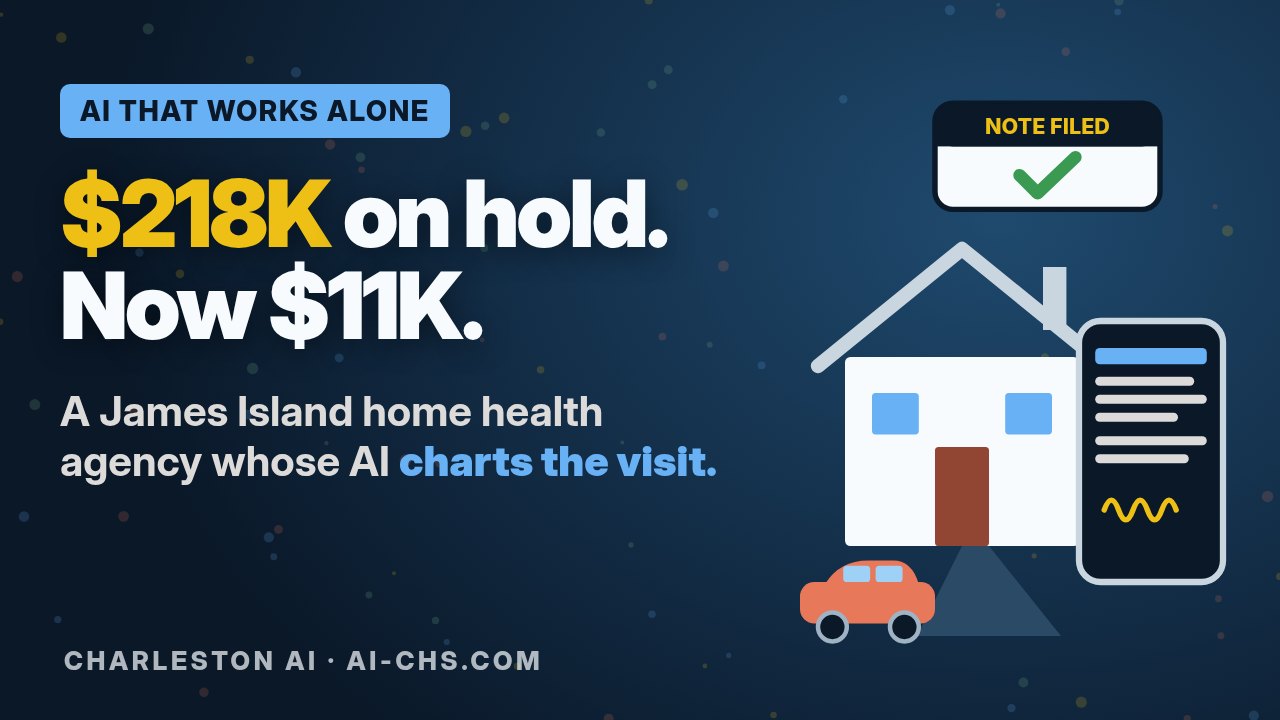
Every clinician gets one at seven each evening: what was filed, what was rescheduled, and the one or two things that need her -- most days nothing but signatures, which take about a minute for a full day of visits. Notes are now signed a median of five hours after the visit. The claims waiting on paperwork at the first of the month have fallen from $218,000 to $11,400. Nobody was asked to give up the AI they chose, and the owner has a clinical record that is true by bedtime instead of by Friday.
"I used to know who hadn't charted by who looked worst at the Monday meeting," she said. "Now everybody looks fine."