She writes 240 words a minute on a machine with twenty-two keys, and reads it back faster than most people talk. She is forty-four, a freelance court reporter who lives off Highway 52 in Moncks Corner, ten minutes from Lake Moultrie, with her husband, who works rotating shifts, and two sons, twelve and fifteen. Her mother lives five minutes away and gave up driving last year. Four reporting agencies in Charleston and Columbia send her depositions: conference rooms on East Bay Street, a plant office in Goose Creek, a doctor's office in Summerville at seven in the morning before the first patient.
The writing was never the trouble. The trouble was everything around a transcript. Every agency books jobs its own way, pays its own rates and wants its own forms. An hour on the record turns into three hours of editing later, and the due date depends on what each lawyer orders, which can arrive days after the deposition.
Regular delivery is ten business days. An expedite can be three, and a daily is tomorrow. She kept it all in a paper planner and a spreadsheet and did the paperwork from nine to midnight. In March an expedite order came in on a Friday afternoon while she was on the record, sat unread under forty other emails, and the transcript went out a day late.
The agency cut her rate on the job and moved her down its call list for a month. In June we set up Muse, Meta's personal agent, on her laptop under her own account and connected it to her email, her calendar and the family's, her invoicing app, her bank deposits, her mileage log, her texts and the shared folder where she keeps exhibits. We wrote it two skills: each agency's rate sheet and forms, and the due-date rules, counted in business days with the state holidays already in. Nobody prompts it.
A booking notice puts the job on her calendar as tentative, with drive time, parking and the caption, and builds a word list from the notice of deposition: every party, attorney, street and drug name spelled the way the filings spell it, ready for her dictionary the night before. When she closes a job and photographs the job sheet, it reads who ordered what, works out each due date and books editing into the hours the boys are at school. Every late order email reruns the week. When she uploads a final transcript, the invoice goes out by page count at that agency's rate, the miles are logged, and at forty-five days unpaid the agency gets a polite reminder.
Deposits are matched to invoices as they land. It never opens a transcript or an audio file. The testimony is not its business; it works only from the outside of a job: the notice, the job sheet, the orders, the page count. It never accepts a job or turns one down, never certifies anything and never argues a rate.
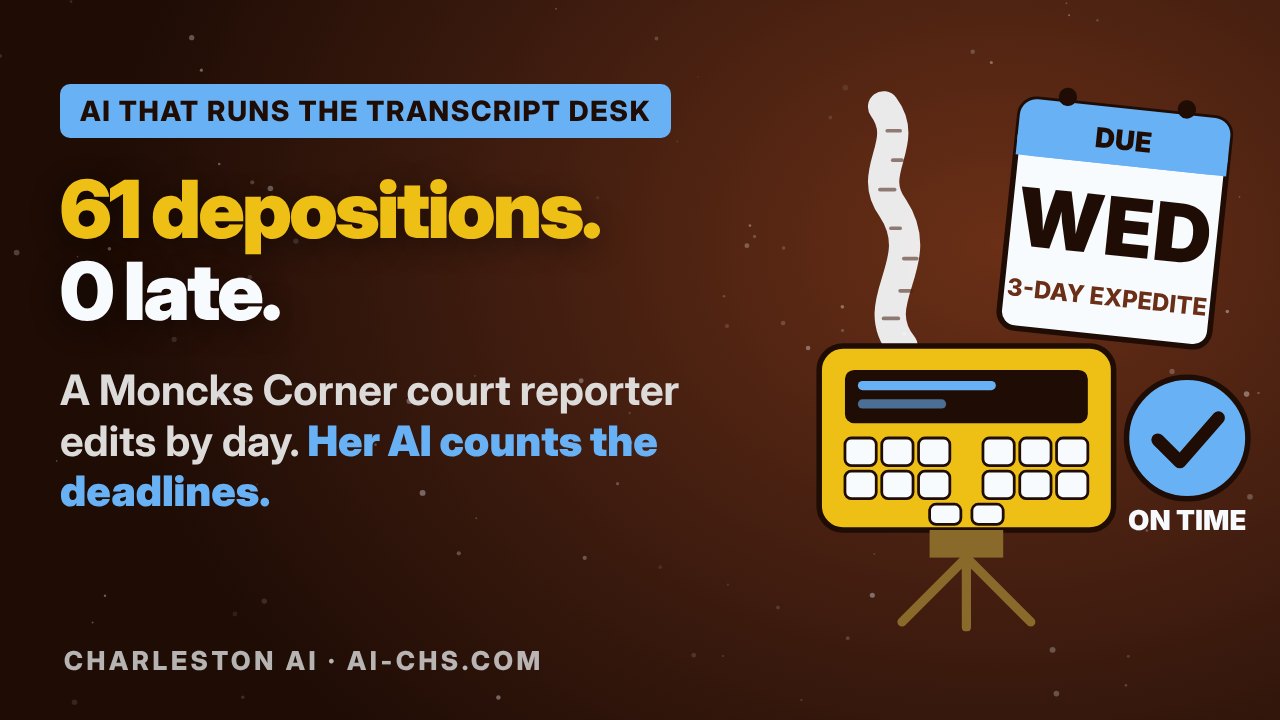
Those come to her. On a Thursday in September she was on the record from nine to five in a conference room on East Bay Street, her phone off in her bag. At 11:40 a paralegal for opposing counsel emailed a three-day expedite on Monday's deposition, due the next Wednesday. Muse worked out that the only way to make Wednesday without a midnight was to edit Friday afternoon, the hours she had set aside to drive her mother to a cardiology appointment in Summerville.
It pushed two regular jobs back a day each, both still inside their due dates, and texted her husband, who was off that Friday. He took the drive. It confirmed the due date to the agency, set the editing blocks and moved Friday dinner to the slow cooker. When she turned her phone on in the parking garage at 5:15, the report was three lines long.
Since June she has covered sixty-one depositions, nine of them expedited, and no transcript has been late. Every invoice goes out the day its transcript does. Agencies used to take fifty-two days on average to pay her; now it is thirty-one, and nothing is past sixty. The planner is in a drawer.
She edits in the mornings now, and on Tuesday evenings she sits in the passenger seat while the fifteen-year-old drives laps of an empty church parking lot, logging his permit hours.