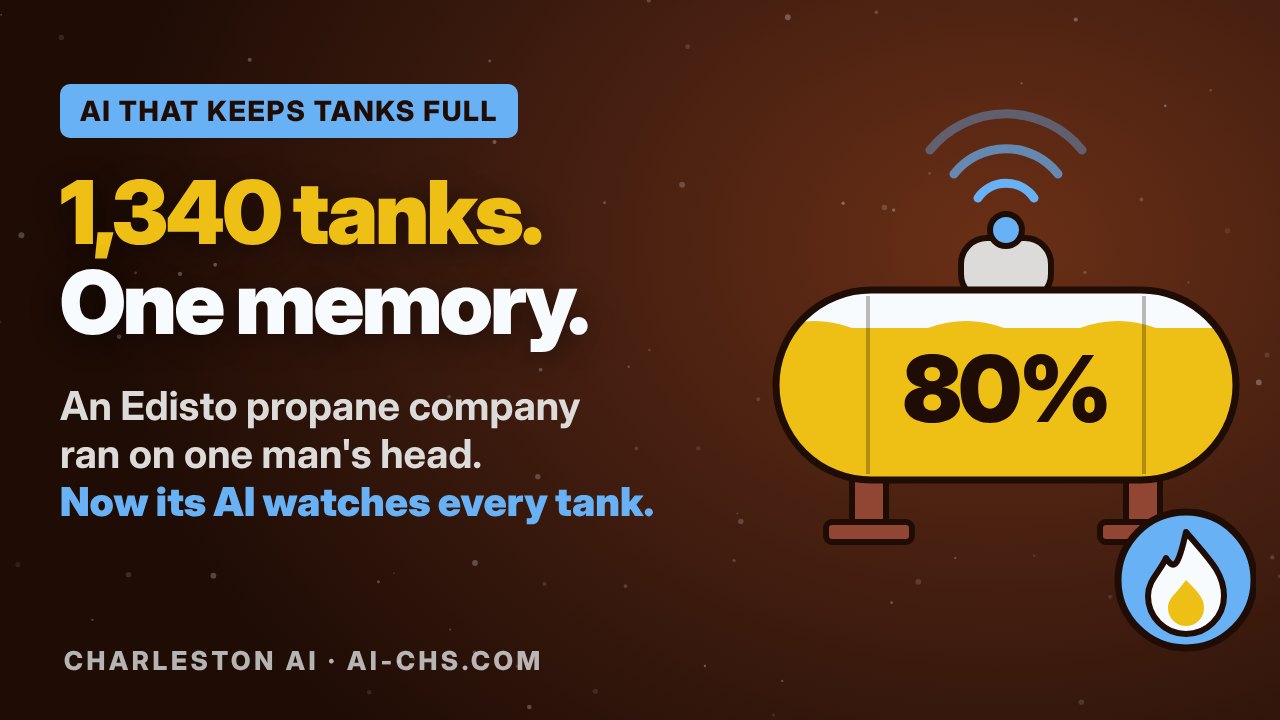
His father delivered the island's first load of propane in 1978, from a truck he bought at a farm auction in Walterboro, and kept every customer on an index card. He is fifty-eight now and still has the cards. The company works out of a gravel yard off Highway 174 on Edisto Island, six miles past the Dawhoo bridge: two bobtail trucks that carry 3,000 gallons each, two drivers, a service technician, and his daughter, thirty-one, who runs the office. Between them they keep 1,340 tanks full, from the beach houses on Palmetto Boulevard to the farms around Adams Run and the shrimp docks on Big Bay Creek.
Every one of those tanks empties at its own speed. A retired couple with gas logs burns forty gallons in a mild month. A rental house whose guests turn on the pool heater burns thirty-five a day. About 410 tanks carry a cellular monitor that reports the level.
The other 930 are a guess, and the guess had always lived in one head, first his father's and then his. Each afternoon he stood at a whiteboard and picked tomorrow's stops from memory, the weather, and whoever had called. The guess was expensive in both directions. Guess early and a truck drives eleven miles down a dirt lane to pump sixty gallons; last year the average drop was 96 gallons, and a stop needs about 140 to pay for itself.
Guess late and a tank runs dry. A dry tank is not a late delivery. Before the gas goes back on, the technician has to pressure-test the lines for leaks and relight every appliance in the house, ninety minutes at least, and for a keep-full customer the company eats it. In one cold week last January eighteen tanks ran out in six days.
The technician worked until eleven every night, and four customers of thirty years called another company. In August his daughter booked two afternoons at the lab on Jessen Lane and brought the office laptop. She did the work herself, with one of us in the next chair. The office already paid for ChatGPT; she connected it to the delivery and billing software, the tank monitors, the office inbox, the texting line, the weather forecast, and the arrival calendars six property managers keep for the rental houses.
Then she and her father spent an hour getting his head into a skill: fill to eighty percent, no keep-full tank below twenty-five, which lanes the trucks cannot take after rain, which gates, which dogs. It runs without being asked. A monitor reading, the morning forecast, a rental arrival, a driver's delivery ticket or a customer's text each wakes it. Every night it re-estimates all 930 unmonitored tanks from the day's temperatures and each house's own history of drops.
At three each afternoon it builds tomorrow's two routes and sends them to the drivers' tablets, and it rebuilds them when a reading changes. It texts will-call customers when their estimate nears thirty percent. It posts each ticket to the account and sends the invoice the same evening. It never sends a truck to refill a tank that ran empty; that goes to the technician first, every time.
It never changes a price or extends credit. And it does not buy gas. Each Monday it tells him how many gallons the week will take, and he calls the terminal himself. On a Friday night in October he was in the bleachers at his grandson's football game in Walterboro.
At 9:38 the monitor on a seafood restaurant's thousand-gallon tank at the beach read forty-four percent. At six it had read sixty-one. One rule in the skill says a tank falling faster than everything on the account could burn is not usage. By 9:41 the AI had texted the technician on call with the address and both readings, texted the restaurant's owner that someone was on the way, and pulled the tank off Saturday's route.
The technician found a fryer's gas line knocked loose from its fitting behind the cook line, shut the valve, and had it repaired and tested by eleven. Back from Walterboro, he read about it Saturday morning, in three lines. Since the first of September the trucks have made 1,912 deliveries. The average drop is 143 gallons, and the two trucks drive about 300 fewer miles a week.
Two tanks have run out, both will-call customers who did not answer three texts. Invoices that used to go out in a Sunday batch go out the day the gas does. The real test comes in January, and he knows it. "I used to lie awake counting other people's tanks," he says.
"Now I lie awake wondering whether to buy a third truck."