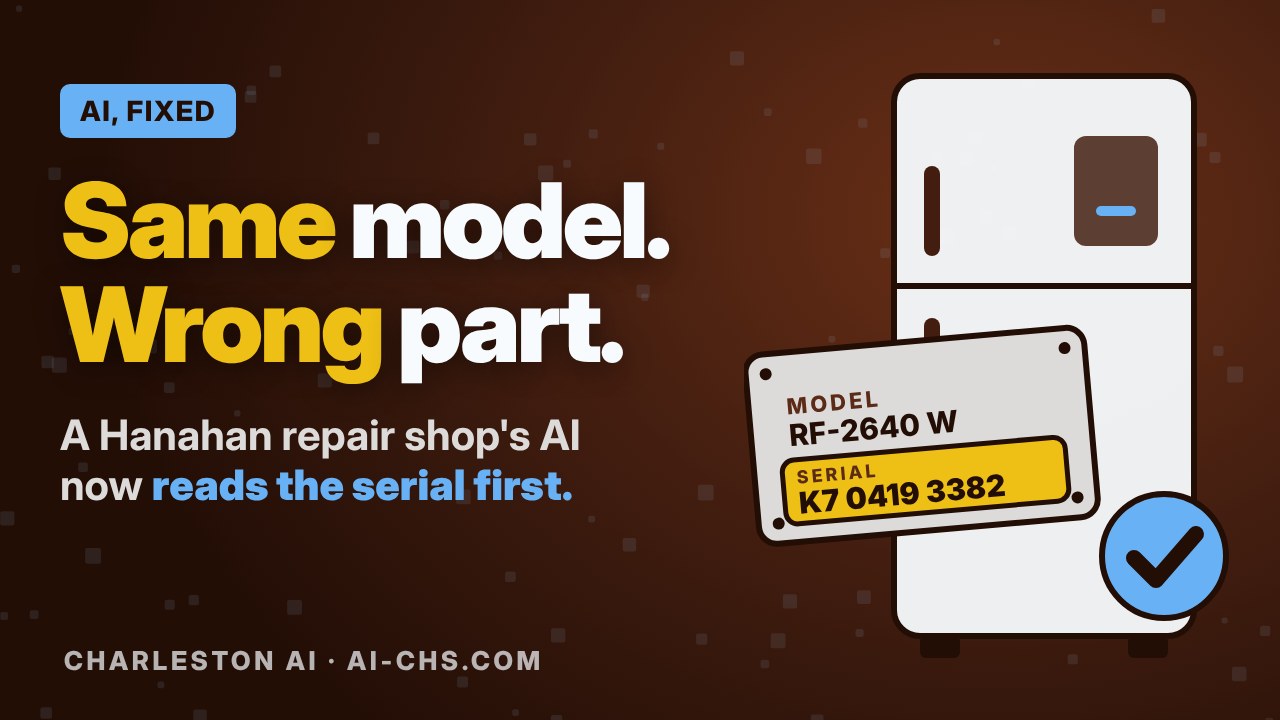
He can find the data plate on any refrigerator with his eyes shut: inside the left wall, above the crisper, a silver sticker the size of a playing card. He is sixty-one. He spent twenty-four years as a factory service technician for a department store chain, and when the chain closed its repair arm in 2018 he bought a used van and kept his customers. Today the business works out of a former tire shop off Yeamans Hall Road in Hanahan: three vans, two technicians besides himself, and his daughter-in-law on the phones.
About 64 calls come in a week, from Otranto to Park Circle, and half of them need a part the van does not carry. Ordering that part was his night job. In April he set up Grok Bot, SpaceX's agent teammate, to take it over. A technician texted the model number and the failed part from the kitchen; it ordered from the distributor in North Charleston and put the return visit on the calendar for the day the part was promised.
Through the spring he thought it was working. It was wrong about one time in six. Manufacturers change parts in the middle of a production run. Two refrigerators with the same model number, built four months apart, can take different control boards, and the only thing that tells them apart is the serial number.
From June through August it placed 412 orders. Seventy-one were the wrong part. Thirty-eight more times the part was simply late, and a van pulled into a driveway on the promised day with nothing to install. That is 109 wasted trips, $1,840 in restocking fees, and a family in Tanner Plantation that lived out of two coolers for eleven days in July.
It also once ordered a $612 compressor on the strength of a text message. By August he had a note taped to his dashboard that said CHECK SERIAL, and he was back to ordering at night. He brought the laptop to Jessen Lane on September 15 and handed it across the table, then stood and watched the way his own customers stand in the kitchen doorway. Nothing was wrong with the AI.
Two things were wrong with what it had been given. Its skill said to order by model number, because that is what he had typed in April. And its parts connector was reading the distributor's public catalog, not his dealer account, which is where the serial-number lookup and the real stock counts live. Both were fixed inside two hours.
The trigger is now a photograph. The technician texts a picture of the data plate, and it reads the model and the serial itself; it will not order from typed numbers. It looks the part up by serial on his account and orders before the van has left the driveway. When two parts still fit, it asks for one more photo, of the number stamped on the old part.
It books the return visit only when the delivery scan shows the box is at the shop. And when the distributor changes a date, it reads the notice the minute it lands. His line is written into the skill. It never orders a part over $350 without him.
It never orders anything for sealed-system work, a compressor or a refrigerant leak; those go to him with the photo. It never tells a customer whether a machine is worth fixing, and it never waives a trip charge. On Saturday, October 17, he was at the coliseum watching hockey with his grandson, phone in his jacket. At 7:12 the distributor backordered a range control board for three weeks; the return visit was Monday, for a woman in Otranto with fourteen people coming for a birthday dinner the next weekend.
It found the same board at the second supplier he had approved, in Columbia, ordered it for Tuesday, cancelled the first order, moved her visit to Wednesday morning and texted her the new day. He read about it Sunday. His report is one text at 6:45 each morning: what arrived, what is booked, and anything it stopped on. Most days the last line says nothing needs him.
Since the fix it has placed 262 orders. Six were wrong, every one on a machine somebody had repaired before with a part that was not original. No van has arrived without its part. Restocking fees for eight weeks came to $150.
The note is off the dashboard.