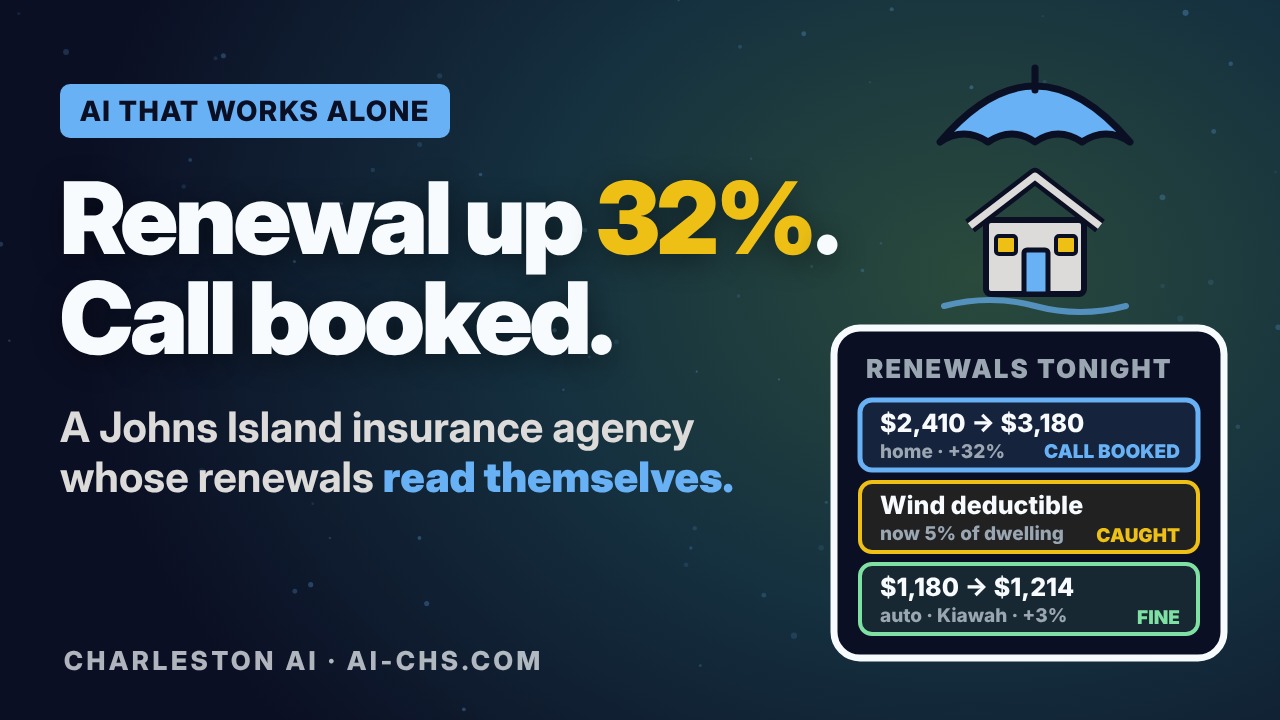
A homeowners renewal does not announce itself. It arrives as one line in a carrier download about sixty days before the policy ends, and for years at an independent insurance agency on Maybank Highway, that line sat unread until the homeowner called. By then the bill had come, or the mortgage company had re-run the escrow and the monthly payment had jumped $140, and the first thing the client heard from the agency was an apology. The agency is six people: the owner, who has been licensed since 1998, a producer who writes new business, and four account managers who each look after about 475 households on Johns Island, Wadmalaw, Kiawah, Seabrook and James Island.
Home, auto, flood and boat. About 160 personal policies renew every month. Over the last three years the carriers writing coastal homes have changed the terms of nearly all of them: higher premiums, wind deductibles that turned from a flat $2,500 into a percentage of the dwelling, roofs older than fifteen years paid at depreciated value, water backup quietly dropped. Nobody had time to read 160 renewals a month against last year's, so the account managers read the ones that called.
The agency was losing about one household in eight every year, and most of the ones that left had left after a surprise. The renewal desk is now an AI running on Anthropic's Claude, wired into the agency's management system, which stays the record of everything. Its trigger is the download itself. Every night, when the carriers post, it reads each renewal against the policy it replaces, line by line: premium, limits, every deductible, every endorsement.
A renewal up less than ten percent with nothing taken away gets a note in the file and nothing more. Anything up ten percent or more, or thinner in any way, it runs through the agency's comparative rater against the other carriers the agency is appointed with, using what is already on file, and it lays out one page: last year, this year and the two best alternatives, with every difference in coverage in plain words. Then it texts the household that their renewal changed and that their account manager has options, and offers three times for a fifteen-minute call or a visit to the office, about thirty days before the policy ends.
When the client chooses, it sends the new declarations page to the mortgage company so the escrow pays the right carrier. It chases flood renewals until they are paid, because a lapsed flood policy starts over with a waiting period. The boundary is written into its instructions and its permissions. It never binds, changes or cancels coverage.
It never recommends a policy, never lowers a limit or raises a deductible to make a price work, and never tells anyone whether a loss is covered. When a client texts "just switch me to the cheaper one," it puts the message at the top of the account manager's queue with both quotes attached. A licensed person decides with the client, every time. The morning that convinced the owner was a Saturday in October.
At 6:40 one carrier posted forty-one non-renewals at once, homes south of the Stono with roofs older than fifteen years, effective in forty-five days. The office was closed. By Sunday afternoon the AI had quoted all forty-one. Thirty-seven had offers from at least two other carriers; four with the oldest roofs could only go to the state's wind pool, which it priced and flagged for the owner.
Every household had a text by Sunday evening explaining what had happened and offering a time. At eight on Monday the account managers came in to a queue with each name, the old price and the options, and twenty-six calls already on their calendars. All forty-one kept coverage. Thirty-nine stayed with the agency.
The owner reads one report, at four on Friday: renewals read, how many changed, calls booked, households lost and anything it could not place. Six months in, every renewal is read before the client sees a bill, the agency keeps about nineteen households in twenty, and the account managers have back roughly fifty hours a month they used to spend on angry calls and rushed quotes. "For twenty-eight years I found out what a carrier did to my clients when my clients told me," the owner said. "Now I know first, and the answer is on the desk before they open the envelope.
My people stopped bracing every time the phone rings."