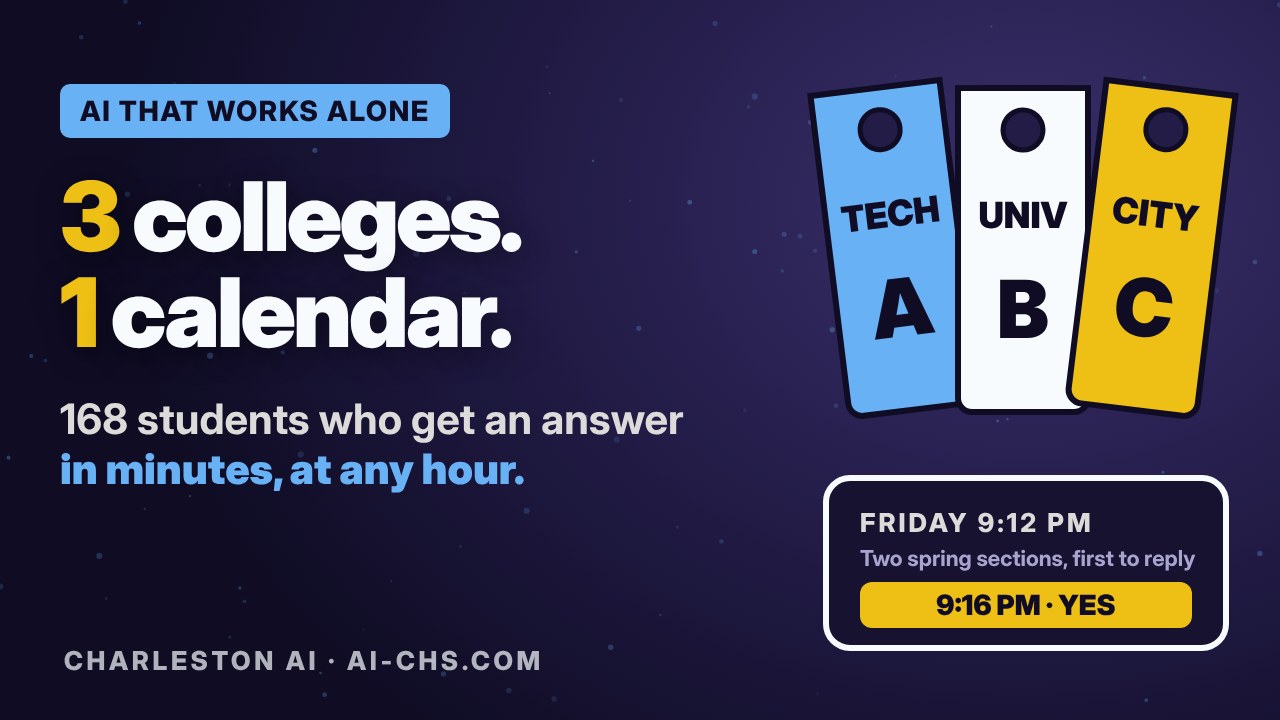
Three parking tags ride in his glove box, one for each campus, and on Tuesdays he swaps them twice. He is forty-nine. He taught English at a high school in Summerville for twelve years, finished a master's degree at night, and in 2019 started teaching college writing as an adjunct. He lives in Lincolnville, the small town tucked against Summerville, in the house off Lincoln Avenue where his grandmother raised him.
He and his wife have a son of fifteen who plays trombone in the marching band and a daughter of ten. This fall he teaches seven sections of first-year writing at three schools: three at the technical college in North Charleston, two at a university off I-26 and two at a college downtown, one of them on Wednesday nights until 8:45. That is 168 students, and each school gave him its own email address, its own learning system, its own calendar and its own deadlines. Attendance has to be verified in the first two weeks or financial aid can stall.
Spring sections are offered in October and November by department chairs who email every adjunct at once, and the first to say yes gets them. About 1,850 student emails come in a semester, and he answered them at night, three inboxes in rotation. The rotation showed. A student waited a little over two days for an answer on average, more than half waited longer than that, and most had asked something the syllabus already said.
Last spring he missed the university's midterm-grade deadline by a day; the memo sat in an inbox he had not opened that week. Last November two spring sections there went to someone else on a Saturday morning. The offer came Friday night, and he read it Monday. Email took him about nine hours a week.
He was already paying for Grok Bot and using it to draft lesson plans. In September we connected it to all three college email accounts, all three calendars and his own, and his logins to the three learning systems, and wrote his rules down with him. Every message that lands in any of the three inboxes is the trigger. If that course's syllabus or course page already answers it, the AI answers within minutes, at any hour, signed so the student knows it came from his AI: the room, the rubric, whether 11:59 means 11:59, how to submit a revision.
It books office-hour visits into one calendar that knows the drive between campuses. On Monday mornings it writes to every student who has missed two assignments, with that school's tutoring hours. Every college memo with a date becomes a block on his calendar with the work scheduled backward from it, and attendance it files itself from the names he taps on his phone in class. Spring sections follow a rule he wrote: any section that fits his week and keeps him at eight or fewer gets a yes the moment it is offered.
It never does the teaching. It does not grade, open a grade book, grant or refuse an extension, or answer anything about a grade, an accommodation, plagiarism, AI on an essay or a student's personal life. Those go on a short note he gets at nine each night, with the syllabus line that applies and the student's record so far, and he answers them before his first class. It never signs a contract.
The same stream carries the house. On Wednesdays, when he is downtown until 8:45, it confirms his wife has the band pickup and sends him the slow-cooker list he approved on Sunday. In October it matched three paychecks against three contracts and caught the technical college paying one section $412 short. The contract and the pay stub went to the payroll office, and the difference came on the next check.
Since September 21, 942 student messages have come in. The AI answered 796 itself, most inside ten minutes. The other 146 were his, and he answered each before his next class. No student has waited two days.
Every deadline at all three schools has been met, and email takes him under four hours a week, most of it reading the nine o'clock note. On Friday, November 6, at 9:12 at night, the university's chair offered two spring sections to every adjunct, Tuesday and Thursday at 1:40. The AI checked them against his class at the technical college, which ends at 10:45 on those days, and against the drive, saw he held six of his eight, and replied at 9:16 that he would take both, contract to follow. The next adjunct replied at 7:02 the next morning.
He was in the bleachers at a football game in Summerville, watching his son's band, and found out on Saturday, when the only thing left to do was sign.