He reads the water meter before he unlocks the door. Nobody has been in the house for three weeks, so the dial should be where he left it. He is fifty-eight. He spent twenty-six years as a construction superintendent building houses on Kiawah and Seabrook, and in 2017 he stopped building them and started watching them: a home watch company, run from two rooms above the shops at Bohicket Marina, near his own house on Seabrook Island.
Four inspectors work for him and an office manager. They hold the keys to 164 houses and villas whose owners live in Charlotte, Atlanta and Cincinnati and come down a few weeks a year. Every house is walked once a week. The inspector reads the meter, takes the humidity in three rooms, looks under every sink, flushes every toilet and closes the visit in an app on his phone: forty-six points, with photographs.
Nobody skipped the numbers. The trouble was that each visit was judged on its own. Fifty-eight percent humidity passes, because the checklist flags sixty, and nobody saw that the same hallway had read forty-nine, fifty-two, fifty-five and fifty-eight four Tuesdays running. A meter that moved sixty gallons in a week looks like nothing unless you remember that it had not moved in a month.
Last year his owners had nineteen water and mold losses, and in eleven the warning had been sitting in the app for three weeks or more. Arrivals were the other trouble. Owners announce them however they like: a text to an inspector, an email to the office, a voicemail to him. Of 212 arrivals last year, twenty-seven families walked into a house that was not ready.
He had Muse, Meta's personal agent, on his phone and used it by voice in the truck. On Tuesday, October 6, he brought his laptop to Jessen Lane. He kept the keyboard for the first hour and connected it to the inspection app, the office texts and email, the calendar, his vendor list and the owner files where each house's instructions live. For the second hour he handed the laptop across the table and we wrote his rules into a skill.
It runs on a closed visit. When an inspector closes one, it lays every number beside that house's last eight visits. A meter that moved in a house nobody has been in is a leak until a plumber says otherwise: it texts the inspector, usually still in the driveway, to go back in and shut the main, books the plumber from the owner's own list and sends the owner both meter photographs. Humidity five points over a house's own average gets a service call, whatever the checklist says.
It also runs on an arrival, however it is announced, working that house's open list backward from the day: water on, water heater on, seventy-two degrees, golf cart on the charger, gate passes requested, a photograph of the thermostat to the owner the afternoon before. The lines are his. It never approves work over $500. It never lets a vendor into a house without an inspector at the door.
It never gives anyone a key, a door code or an alarm code, and it never tells an owner what a repair will cost or what insurance will do. Water standing on a floor does not get a text; it rings his phone. And it never closes its own finding. Only the next reading does.
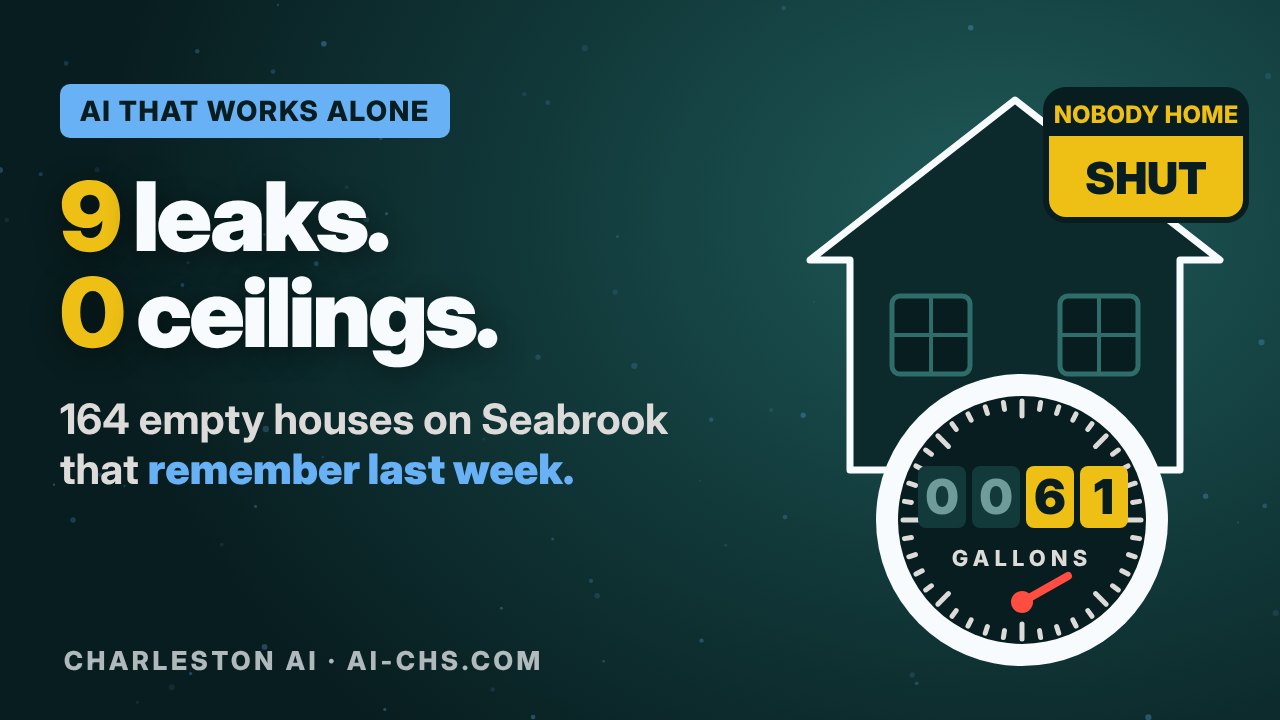
On Friday, October 30, he was on Interstate 26 to his granddaughter's volleyball tournament in Columbia when the last visit of the week closed at 4:35. The meter at a house behind the dunes had moved sixty-one gallons in seven days. For three weeks before, it had not moved. At 4:37 the inspector was back inside shutting the main.
By 4:50 the plumber was booked for Monday at eight, the inspector was set to meet him, and the owners in Cincinnati had two photographs and four sentences. On Monday the plumber opened the laundry room wall and found a pinhole in a copper line. The drywall was damp and nothing had come through. The bill was $340.
He read about it Saturday at 7:15, in the one text he gets each morning. It ended, "Nothing needed you." In six weeks it has read 984 visits. Nine meters moved in empty houses: six running toilets, two irrigation valves and the pinhole.
None ran longer than the week between two visits. Fourteen houses were climbing toward sixty percent. Ten were fixed with a service call, and four are on his list, because replacing an air handler is an owner's decision. Thirty-one owners have arrived, and thirty-one houses were ready.
He still reads the meter before he unlocks the door. He is just no longer the only one who remembers what it said last week.