She has lived on Kiawah Island for eleven years, in a rented cottage near the front gate, and she teaches tennis on the island's green clay courts by the hour. Thirty-eight regular students buy ten-lesson packages at $95 a lesson, and a steady stream of resort guests want one lesson during their week. In a normal week she teaches about 35. She also has a twelve-year-old son at a middle school on Johns Island whose day ends at 3:00, a travel soccer schedule on weekends, and physical therapy for her own knee twice a week in West Ashley.
The weather was the expensive part. A sea breeze front or a line of afternoon storms would rain out two or three lessons a week, and because she checked the forecast once at six and then had a racquet in her hand all day, she usually found out on the court. She texted each student to rebook, and about half answered. The packages lived in a spiral notebook in her tennis bag, and roughly one lesson in ten never got its tick mark: about $475 a month taught for free.
Resort guests who texted for a lesson waited hours for a reply and often booked someone else. She answered about fifteen texts a day between lessons, and the one fixed point in her week, the 3:00 pickup, was the thing that got squeezed. Her AI now runs the whole week in one stream. It watches the hourly forecast and lightning data for the island, the tennis center's court sheet, every text, every payment notice, the school calendar and her therapy schedule.
Nobody prompts it. When the forecast shows lightning within ten miles or heavy rain in a lesson hour, it offers that student the nearest dry open slot hours ahead, moves the lesson on yes, and releases the court so she is not charged for it. When a lesson ends, it logs it against the student's package and sends the receipt, and when a package is down to two lessons it sends the renewal link. It matches every Venmo and Zelle payment to a package and moves a share of each deposit into the account she keeps for quarterly taxes.
Resort guests on the wait list get her open slots within minutes. It orders groceries Thursday night for Friday delivery and books her knee appointments around her lessons. It has three fixed edges. It never schedules anything over the 3:00 pickup or her son's games; a student who asks for 3:00 is offered 4:00.
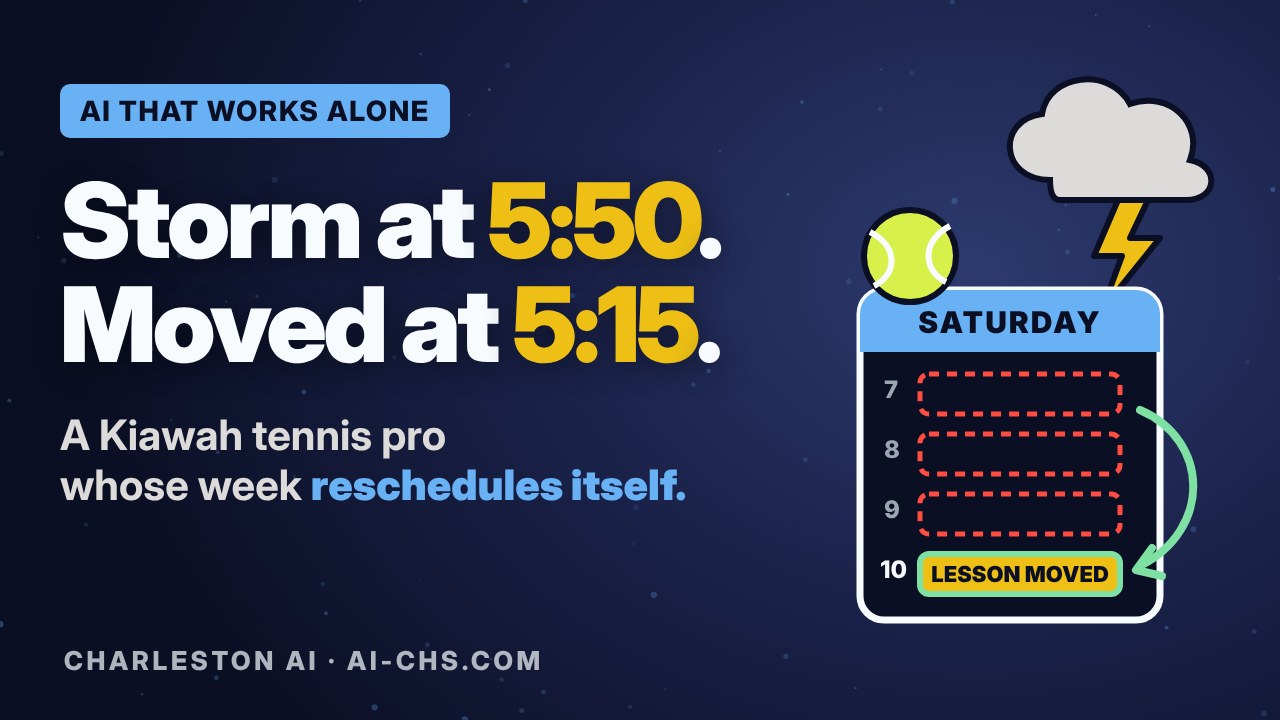
It never books a court the tennis center has blocked for a tournament, and when the center blocks one, it moves the lessons before anyone drives over. And it never charges or forgives a late-cancel fee. Those go on her report, because they are about relationships, and she decides. On a Saturday in October a line of storms formed offshore earlier than any forecast had shown.
At 5:15 in the morning the AI saw it on radar, due over the courts at 5:50 and clear by 9:30. She was asleep after a late soccer tournament in Summerville. It moved the 7, 8 and 9 o'clock lessons into open slots later that morning and the next day, released the courts, and texted a guest family from Ohio a 10:00 time, which they took. When she woke at eight, the day had already rebuilt itself around the rain.
The report arrives at eight each evening and is usually one line: a late cancel for her to decide, or nothing at all. Eight weeks in, weather costs her about one lesson a month instead of two or three a week. Every package lesson is logged, so the $475 a month comes back. Guests who used to go elsewhere now fill her open hours, and she teaches about 42 lessons a week instead of 35 without adding a single early morning.
She answers about one text a day herself, and she has not been late for the 3:00 pickup once.